

South Hill
Spokane's historic luxury neighborhood — Manito Park, mature trees, 1900s–1920s character architecture, and top-tier public schools.
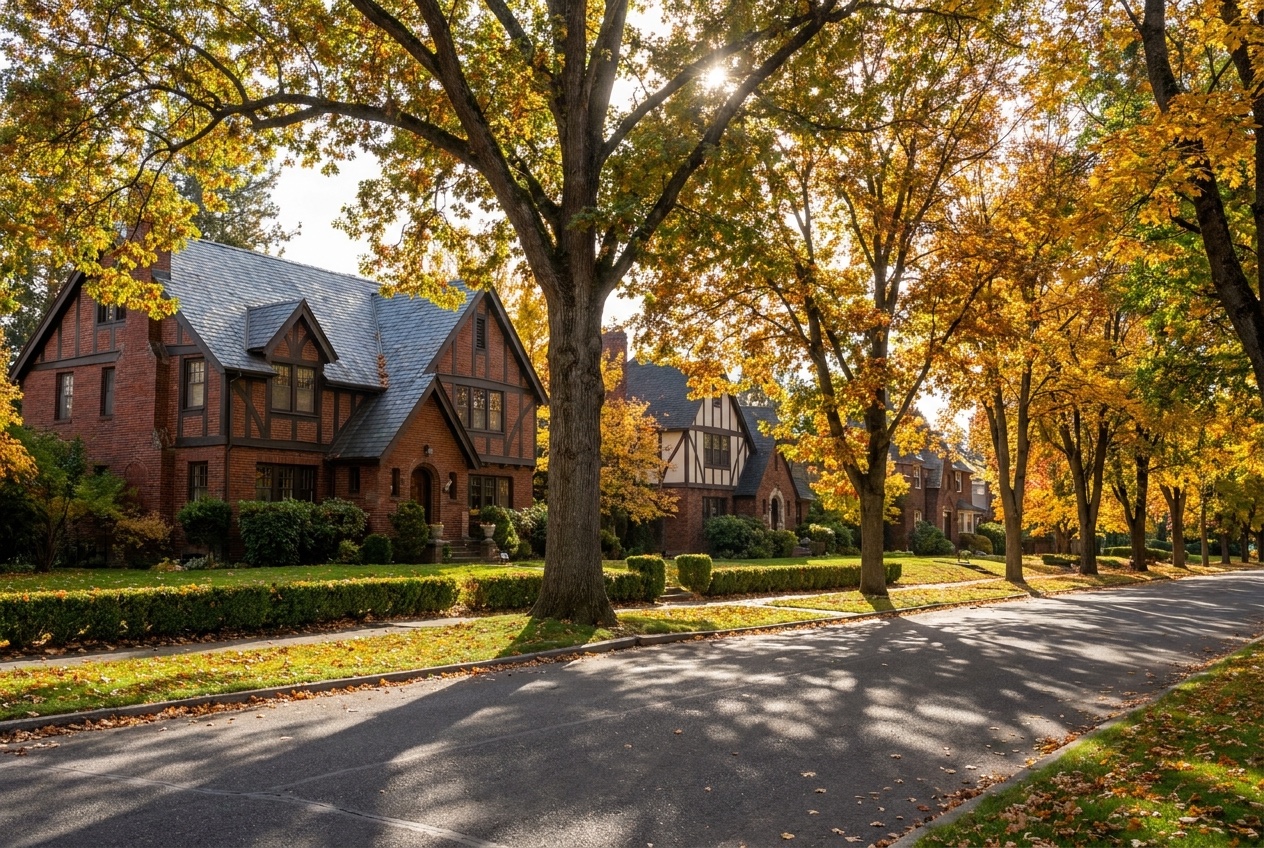
South Hill is Spokane’s historic luxury neighborhood, a tree-lined plateau in Spokane County, Washington, immediately south of downtown across the railroad cut. It is anchored by Manito Park — 90 acres including the Nishinomiya Tsutakawa Japanese Garden, Duncan Garden, and Rose Hill — and characterized by 1900s through 1920s estate architecture (Tudor Revival, Colonial Revival, Craftsman) on lots far larger than the typical Spokane grid. Median sales run $550K to $1.2M, with the established estate tier from $1.5M to $5M and select trophy properties higher.
At a glance
- Schools: Spokane Public Schools — Roosevelt Elementary, Sacajawea Middle, Lewis & Clark High School
- Median price band: $550K–$1.2M; estate tier $1.5M–$5M
- Construction era: predominantly 1900–1930 with selective infill
- Park: Manito Park (90 acres) — gardens, conservatory, walking loops, dog park
- Medical: Sacred Heart Medical Center adjacent (Level II trauma)
- Commute: 5–10 minutes to downtown Spokane via High Drive and Bernard Street
What makes it different
South Hill is the only neighborhood in eastern Washington with a genuinely deep stock of pre-1930 estate architecture. The Rockwood Boulevard / 9th Avenue / High Drive corridors hold an inventory of architect-designed homes — Kirtland Cutter, Harold Whitehouse, Loren Rand — that does not exist anywhere else in the region. Lot sizes on the older streets run a quarter to a half acre, with mature deciduous canopy that has been in place for a century.
The walking experience compounds the architectural one. From most South Hill addresses a buyer can walk to Manito Park, to Sacred Heart, to Rockwood Bakery and the small commercial nodes on Grand and 29th. It is genuinely walkable in a way the bluff neighborhoods north of the river are not.
Who lives here
The dominant buyer is the established Spokane professional — physicians, attorneys, business owners — often second- or third-generation in the city. Sacred Heart Medical Center directly feeds the buyer pool. Secondary profiles include relocating executives drawn to the architecture and the school district, and empty-nesters from the suburbs returning to walkable in-town living. Year-round residency runs near 100%.
The catch
The housing stock is old, and the carry costs reflect it. Pre-1930 homes carry deferred-maintenance realities — knob-and-tube wiring, original plaster, lath, single-pane fenestration, lead paint, asbestos in mechanicals — that newer-construction buyers are not used to underwriting. Comprehensive inspections matter more here than anywhere else in the region. Mature trees are an aesthetic asset and a real-cost liability: removals and trims are not cheap, and storm damage is not rare.
How it compares
South Hill is Spokane’s character-architecture neighborhood; Five Mile Prairie is its newer-construction counterpart. South Hill delivers mature trees, walkability, and pre-1930 estate housing; Five Mile delivers newer construction, the Mead School District, and downtown view inventory. Buyers choose South Hill when architecture, walkability, and central location outweigh the maintenance profile of an older home.